Turkmenistan Visit May 2012 – Linda LaBelle
My whirlwind visit to Turkmenistan May 20th thru May 27th was an incredible experience. So much work went into planning this trip that covered my meeting with several different groups. And it was the attention to detail that helped to make this a successful trip.
We were able to accomplish several firsts – showing a film as part of my speaking tour and doing hands-on workshops. Not being sure how the film Blue Alchemy:Stories of Indigo (an English speaking film by Mary Lance about indigo production around the world) would be received it was with great relief that much interest was shown at each viewing. It also helped that the Embassy had translated the script into Turkmen and had handouts of the script available. At the one-day workshops a lovely woman simultaneously translated as the film ran.
Monday May 21st would be a light day for me. I was excited to arrive at the Embassy and meet with the people who had worked so hard to make this trip happen. After going over my itinerary and having lunch we were off to the Carpet Museum and then a visit to with the Turkmen Carpet State Joint-stock Corporation.
In anticipation of the International Carpet Conference there was a carpet competition going on and we arrived at the museum as the awards were being given out. The museum is beautifully set up to showcase the carpets of Turkmenistan and an English-speaking guide led our tour. By the end I had an entirely new appreciation of the knotted pile carpet.
After our tour we met with the Chairman of the Turkmen Carpet State Joint-stock Corporation, and some of his staff. I had prepared a list of possible contacts in the US that they might want to approach to sell their carpets to – but my sense is that there is little interest in exporting the carpets – sales are very strong domestically.
On Tuesday May 22nd we visited the Institute of Culture. There we met with the Director and learned the history of the Institute. For my talk and demonstration we were set up in a medium-sized classroom with approximately 30 young women and their professors. Due to time constraints we were able to only show part of Blue Alchemy (covering Indigo in India and Japan). We had a lively Q&A after the film and then I did an indigo dyeing demonstration. Everybody loved it! They asked to keep the dye-bath and fortunately we had a plastic bucket we could transfer the dye to. I always look for small clues that tell me what I am doing is working – on this day it was one of the professors hurrying down the hall to catch me as I was leaving to show me a ball of yarn that had been dyed in indigo long ago!
After the Institute of Culture we stopped by the Chancery for a meeting with Ambassador Robert Patterson. It was a pleasure for me to talk with him about natural dyes and what we were hoping my visit would accomplish.
Next we were on our way to tour a government run carpet factory and to have lunch. It was actually a carpet holiday and lunch was a party with decorations, special foods, music and dancing.
Because of the holiday the weavers were not working but we did get to see some of the workrooms with huge looms. It seems that making room-sized carpets is the new trend. There could be 20 to 30 women working side by side on these giant looms. The looms for these large carpets lay flat on the floor, the women sitting on cushions on a board bending over to weave – how hard that must be on one’s body I can only imagine! I have to say that what we saw of the facility was clean with natural light and good ventilation.
Our day was not yet over – My embassy hosts and I were on our way to the airport to fly to Turkmenabat where we would spend the night before driving to Halach in the morning!
Wednesday May 23rd started with breakfast by the river before we began our 2½ hr drive to Halach. It was nice to get out of Ashgabat and see more of the countryside. Here people were more relaxed – freer to mingle and talk. On our drive we passed Mulberry trees, cotton and wheat fields.
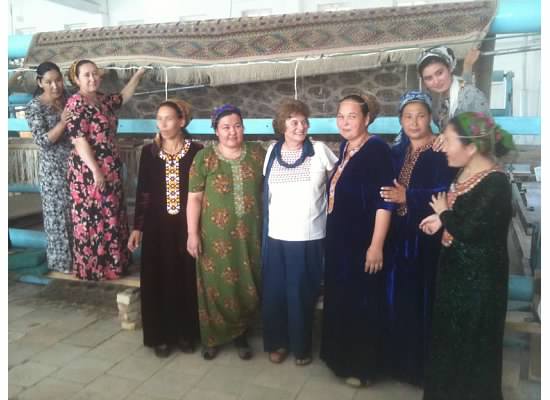
Our first stop in Halach was a government run carpet factory. Again the building was open with natural light and good ventilation. Here the women were busy at work on carpets of varying sizes. One carpet was about to come off the loom and I was invited to sit down and help tie the finishing knots before the warp was cut. The ladies each took a warp yarn from the loom and tied it around their heads – and mine too! What was the symbolism? They tie the warp yarn around their heads while removing the finished carpet so that the work will continue; it will not end with this carpet! I was then given the honor of cutting the carpet from the loom.
After the warp was free from the loom and lots of pictures taken we walked over to another loom. Again I was invited to sit down beside the weavers and was shown how to make the knots. Sitting in close quarters, on a low stool and with little air (we were at the back of the room away from the windows) I began to sweat as I tied the knots – one had to be quick and have very agile fingers. The women make the patterns from memory or have a schematic drawn on a paper grid – as they finish a row of knots a pinprick is made on the schematic to indicate that row is finished. Weavers are paid by the knot, there can be many thousands of knots in a carpet.
Next we were on to the home of a natural dyer who owns a private carpet factory. I found this visit quite interesting on many levels. We got to see some of the actual plant matter that they used in dyeing their wool and silk yarns. To keep the moths away from their woolen yarns they had laid fresh Wormwood stalks on top of the piles of yarn. For some reason our photographing this was not well received – the dyer told us it was his secret and he did not want others to see this. I found this curious as Wormwood is used all over Central Asia as a natural moth repellent.
We sat down to have tea, lunch and talk. Things turned interesting – in my work as a dyer I am not usually seen as a “woman” I am seen as a dyer, an artisan, an expert in what I do. Here I was being dismissed and I am sure it was because I am a woman – there wasn’t much interest in what I do – this man had learned from a master and he had little to say to me. I had brought Cochineal bugs to show and his reaction was “Are you advertising (selling) these?” I was a bit taken aback, replied no – just thought he might be interested. We moved on to his colors for his rugs and he admitted that while all the colors are natural, the blue in his rugs is synthetic. When pressed as to why they were not using indigo his father told us that years before they had traveled to Pakistan and bought a large quantity of costly indigo. When they returned home they boiled it up and it didn’t work. So after some time they were able to sell the indigo to someone else (at a profit) thinking the person a bit of a fool for buying it (because it doesn’t work) and had a good laugh. At last we had an opening for a dialogue – I explained that by boiling the indigo they had actually killed it and would they like me to do an indigo dyeing demonstration for them? The son said yes and we went off to a kitchen area where I prepared the indigo pot, once it was ready I dyed a bit of his wool yarn, still skeptical he was sure the interior of the yarn would be white – when he cut into the yarn it was blue – and here is where things turned around – the fellow got excited and began to ask questions. We left the dye bath with him and I am sure he spent the afternoon experimenting with the indigo pot!
His mother honored me with an invitation to spend the night and told me they would kill a sheep for the occasion – fortunately for the sheep I had to return to Ashgabat!
Before we left Halach we set off to visit the family’s weaving facilities. Once done at the family’s compound, the looms were now spread out to different places. One stop was at the grandmother’s compound. Here in a dark room with a dirt floor, little ventilation and a bare light bulb sat the four daughters-in-law weaving a carpet. There was just enough room for the loom. I have to say I was a bit shocked to see this after the government run factories. We then drove to another one of their facilities where a silk rug was being woven. The weavers were schoolgirls. Once the school day was over the young girls would walk to this place and begin work. Here there the space was roomier with natural light and ventilation.
It was now time to leave Halach and drive back to Turkmenabat to catch our plane. When we arrived in Turkmenabat we still had a little time. I was able to visit the American Corner there and chat a bit with some of the young people participating in the program. I was very impressed with both the physical space and the programs offered.
Thursday May 24th – The first workshop! So much planning had gone into the workshops and now the first one was about to begin. We arrived to a wonderful workspace a half hour outside the center of Ashgabat. There was plenty of space for the dye pots, lines to hang the yarn and fabrics we would dye. A room in which we could show the film, Blue Alchemy, during lunch and best of all eager participants! Jamilya and her husband were the liaisons between the Embassy and the participants. They also did a great job of gathering many of the necessary chemicals and materials to supplement what I would be bringing. We had cotton, silk and wool yarns to dye along with silk and cotton fabric. It was a long and exciting day – we made beautiful color, the participants asked great questions and they were able to go home with pages of my dye formulas translated in to Turkmen (thanks to the Embassy!).
Friday May 25th – Day two of the dye workshops. Unfortunately I had become a bit ill during the night so I was not 100%. I needed a little more time before I could venture out of my hotel room. My Embassy hosts were there to help. The day began with the film, which I am told the participants loved! I arrived at the workspace to find Jamilya had taken charge! Yarns were soaking, yarns were in the mordant pots and dyes were being prepared. I was so pleased to see this. Jamilya had learned so much in one day. Everyone was so kind and patient with me, the family whose house we were at let me rest in one of the rooms during lunch and brought me tea made from fresh daisy flowers. And even though the day was shortened we still made beautiful colors and had a great Q&A session.
For both days we had an interesting mix of people – weavers, felters, artisans, a research scientist, a woman who raised camels, even an alpinist! My impression – they were thirsty for knowledge and just drank it in.
I know that we were able to spark interest in natural dyes and my reward – to learn that Jamilya will be conducting a natural dye workshop in the near future! I can still feel the excitement and see the beautiful colors we made on those two days.
Saturday May 26th – Opening ceremony for the International Carpet Conference. I have to be honest here and say that as my Embassy host and I were driving to the conference site I was not overly excited, after all a conference is just a conference – ho-hum. Well not true in Turkmenistan! The minute we reached the front of the carpet museum it was an Oh Wow! Moment and my excitement level went through the roof. The entire expanse of sidewalk outside the museum was covered in carpets, the stairs were covered in carpets, and the banisters were covered in the most incredible fringes. Then there were the people – women in the most beautiful dresses and head scarves, men in shiny silk suits, a man from Afghanistan in a green, white and pink stripped silk robe, a sheik in a golden robe made from the sheerest silk. There were dancers and singers and musicians and more carpets. When the speeches were over we were invited inside the museum. The museum consists of alcoves where the carpets are displayed, this day each alcove was a vignette of Turkmen life representing the five tribes and five regions. And of course carpets everywhere!
Outside, at the back of the museum, was more to see. There were sheep being shorn, and wool being washed, combed, spun and dyed with natural dyes. There were weaving, felting and knitting demonstrations. Across the way yurts were set up and families dressed in colorful garb were cooking regional dishes – there was even popcorn being made in a plouv pot over a wood fire! There were also horses and camels to see. And of course more carpets! All of this taking place under a brilliant blue sky.
We then got on busses to travel to a banquet hall for lunch. I was under the care of a lovely woman from the museum and still not up for eating, somehow she wrangled Kefir and green tea for me!
After lunch we traveled to the National History Museum. There we found they had arranged for tour guides in a variety of languages. Three of us (a German, a Russian and I) set off with the English-speaking guide. The tour was a lot of fun and the textile section was my favorite.
After the tour I sat with a group of women. At first I didn’t understand what they were trying to tell me. They wanted to know where I was from, I replied America. One said Iran Turkmen and another said Pakistan Turkmen and another Uzbekistan Turkmen and asked me American Turkmen? It took several tries and then I realized they were telling me they were Turkmen living in Iran and Pakistan and Uzbekistan and wanted to know if I was a Turkmen living in the US. I replied no. With a little help from a woman who spoke a small amount of English and sign language we had a great conversation and much laughter.
Soon it was time to get back on the busses to return to the Carpet Museum, the day was over.
Fun fact – the Carpet Ministry got my name wrong for my conference badge – so for the remainder of my visit I was Lindi Label!
The evening was highlighted by a visit to the home of the Deputy Chief of Mission for movie night. Here I had an opportunity to chat with some of the young Turkmen students involved in exchange programs with the US.
Sunday May 27th – my last day & the Carpet Conference. This was an interesting day. I was to arrive at the Carpet Conference early, by 8:30, to deliver my presentation paper and PowerPoint in English for the translators. My presentation – Natural Dyes from the Beginning of time to the 21st Century presented in nine minutes!
The conference was to start at 9:00, my Embassy host would arrive at 10:00 and I was to present at 11:00. All the details had been triple checked. The headers for my PowerPoint had been translated into Turkmen (this was to become more important than I realized). At 9:45 I heard my name, I was being called up an hour and 15 minutes early to present my paper. Here is the crazy part – the room was packed, but only the first row (mostly presenters) had earphones for the translations. So while I spoke in English and my words were being translated into Russian and Turkmen only a small number were hearing the translation, and that is why it was so great that the headers were in Turkmen – at least a little of the presentation got through to those without earphones! As I was winding up my presentation I spotted my Embassy host in the audience (much to my relief). She was able to get the okay for me to leave the conference after my presentation and once I did a couple of interviews we left. It was disappointing to me that the entire audience was not able to hear the translation of not only my presentation but others as well.
My short afternoon was spent doing a little shopping and then it was off to an end of the year picnic at the International School. It was a fun contrast of American baseball, blankets on the lawn and the national dish – Plouv. This was another opportunity for me to interact with the Turkmen folks in a freer, less formal atmosphere. One of my favorite things – the new classrooms at the center, they are air-conditioned yurts!
Pretty soon it was time to return to my hotel and finish packing, my time in Turkmenistan was coming to an end.
This visit was outlined with specific goals in mind and I feel those were achieved:
1- Generate interests and skills in Turkmenistan’s textile industry
2- Expand points of reference for Turkmen’s citizens
3- Build trust with the government in a demonstrated area of interest
4- Serve as a catalyst for grantees.
Textiles have a unique language all their own that crosses most barriers whether it’s language, politics, even status. The makers, dealers, collectors and suppliers speak this language of textiles with excitement, curiosity and respect. It is spoken in the cities and the countryside. Textiles adorn bodies and homes, even animals, they are frivolous and utilitarian, they keep us warm or cool, they tell our age and status within the community, they tell where we are from. None of this was truer than what I experienced in Turkmenistan!
I hope you enjoy the slideshow below!
This slideshow requires JavaScript.
Carpet Expo




 Madderlane